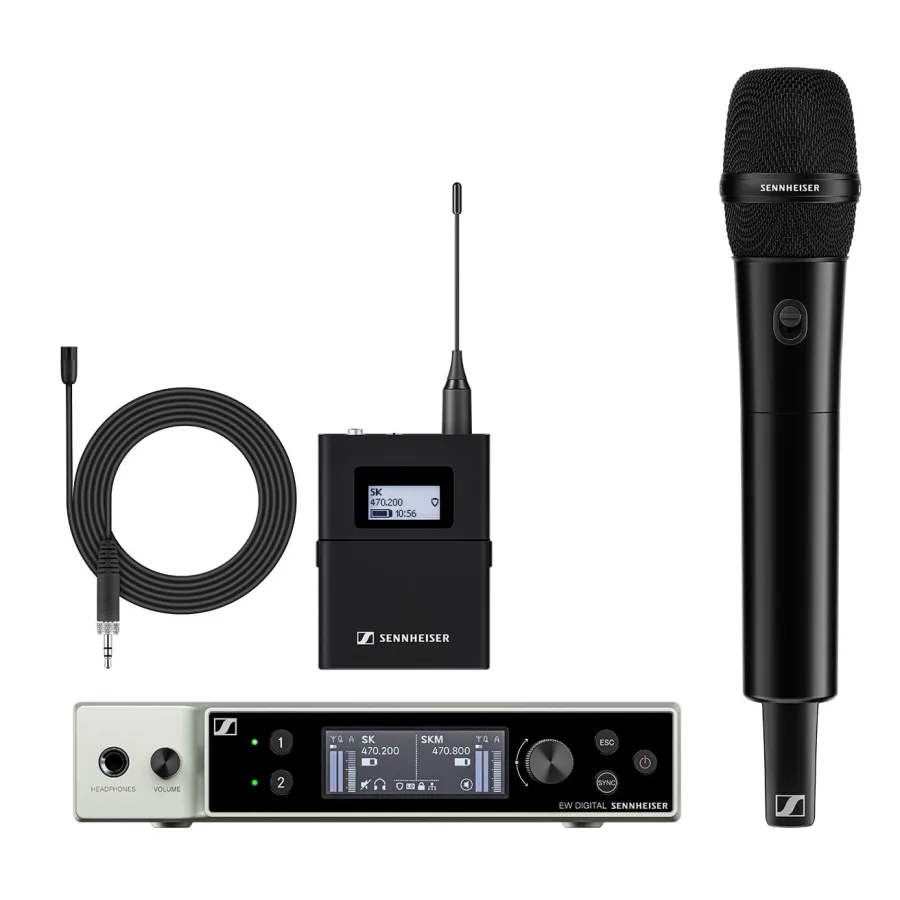
Sennheiser's evolution wireless family shows up on more riders than almost any other wireless brand. Two systems cover most requests: the analog EW 500 G4, a workhorse that's been on stages for years, and the digital EW-DX, its modern successor. Both sound great. The right choice depends on channel count, the RF environment and what the performer is used to.
The quick answer
- Choose EW-DX for high channel counts, crowded RF, wireless instruments where latency matters, or events that need encryption.
- Choose EW 500 G4 when the rider specifies it, when you're adding channels to an existing G4 rig, or for straightforward vocal and presenter work with a modest channel count.
How they differ
| EW 500 G4 | EW-DX |
|---|
| Transmission | Analog FM with companding | Digital UHF |
| Latency | Effectively none (analog) | About 1.9 ms |
| Multi-channel planning | Needs intermodulation-free frequency sets | Equidistant channel grid |
| Dense channel counts | Good, with careful coordination | Very good; Link Density mode for crowded spectrum |
| Encryption | No | Optional AES-256 |
| Capsules (handheld) | Sennheiser evolution capsules | Sennheiser evolution capsules |
Sound
The 500 G4 uses analog transmission with a compander: the signal is compressed before transmission and expanded at the receiver. It sounds natural and familiar, and many engineers know exactly how to EQ it. EW-DX digitizes the signal in the transmitter, so there's no compander character and a very low noise floor. Most listeners won't hear a difference on a loud rock vocal; on quiet spoken word or a dynamic singer, the digital system is noticeably cleaner.
Latency
Analog wireless is effectively instantaneous. EW-DX adds roughly 1.9 ms — less delay than standing an extra couple of feet from a guitar amp. For vocals it's irrelevant. For wireless guitar or bass feeding in-ears, it's still low enough that players rarely notice, but it's worth knowing if you're stacking other digital stages (digital console, digital IEMs, digital pedals) in the signal path.
Frequency coordination
This is where the systems differ most. Analog systems interact in the air: two transmitters can create intermodulation products that land on a third channel and cause noise or dropouts. Coordinating a large analog system means choosing frequency sets that avoid those products, which uses spectrum inefficiently.
EW-DX is designed to work on an equidistant grid: channels spaced evenly, without the intermodulation math between EW-DX channels. In practice you fit more channels into the same clean spectrum, and setup is faster. Its Link Density mode halves the channel spacing to squeeze in even more channels, trading a little range (Sennheiser cites roughly 10%) — useful at festivals and broadcast events. Note that EW-DX still has to avoid TV stations, other systems and IEM transmitters, so a scan and a plan are still essential. More in wireless frequency coordination in Los Angeles.
Encryption
For corporate events, earnings calls and private board meetings, the EW-DX's optional AES-256 encryption keeps audio from being picked up by a scanner in the parking lot. Analog systems can't offer that.
Handhelds, bodypacks and capsules
Both systems use Sennheiser's evolution capsule thread, so handheld transmitters accept the familiar capsule family (for example dynamic and condenser options like the MMD 835, MMD 935 and MME 865). If an artist travels with their own capsule, it will usually fit either handheld.
Bodypacks cover lavalier and headset mics for presenters and theater, and instrument cables for guitar and bass. Confirm the connector your mic or cable uses when you order; it's one of the most common day-of surprises.
Which to rent for…
Lead vocals at a club or theater show
Either. If the rider specifies one, rent that. If the engineer has no preference and you have more than six or eight channels in a busy venue, EW-DX simplifies the coordination.
Wireless guitar and bass
EW-DX instrument bodypacks give clean, wide-bandwidth audio with low latency. Many players also run digital pedal wireless; ask what's already in their chain.
Corporate keynotes and panels
EW-DX, for encryption and low noise on spoken word. Pair handhelds for Q&A with bodypacks and headset or lavalier mics for presenters. Plan on spares — corporate shows always add a presenter.
Festivals and multi-act stages
EW-DX for the house channels, with coordination that also accounts for every touring act's analog and digital systems.
Adding channels to an existing G4 rig
EW 500 G4 keeps everything consistent: the same receivers, menus and sound across all channels.
Rental checklist
When you order wireless, include:
- Number of handheld and bodypack channels, plus spares
- Capsule preference for each handheld
- Lavalier, headset or instrument cable for each bodypack, with connector type
- Antenna needs — remote paddles for large rooms or outdoor stages
- Batteries or rechargeable packs for the whole show day (our battery guide)
- The venue address, so frequencies can be planned against local TV stations
Looking at a show in Los Angeles? Browse our wireless inventory — EW-DX, EW 500 G4 and EW IEM G4 — or send us your channel count and we'll recommend a setup.